Building Beyond the Browser: Four Projects at the Intersection of Software, Energy, and Engineering
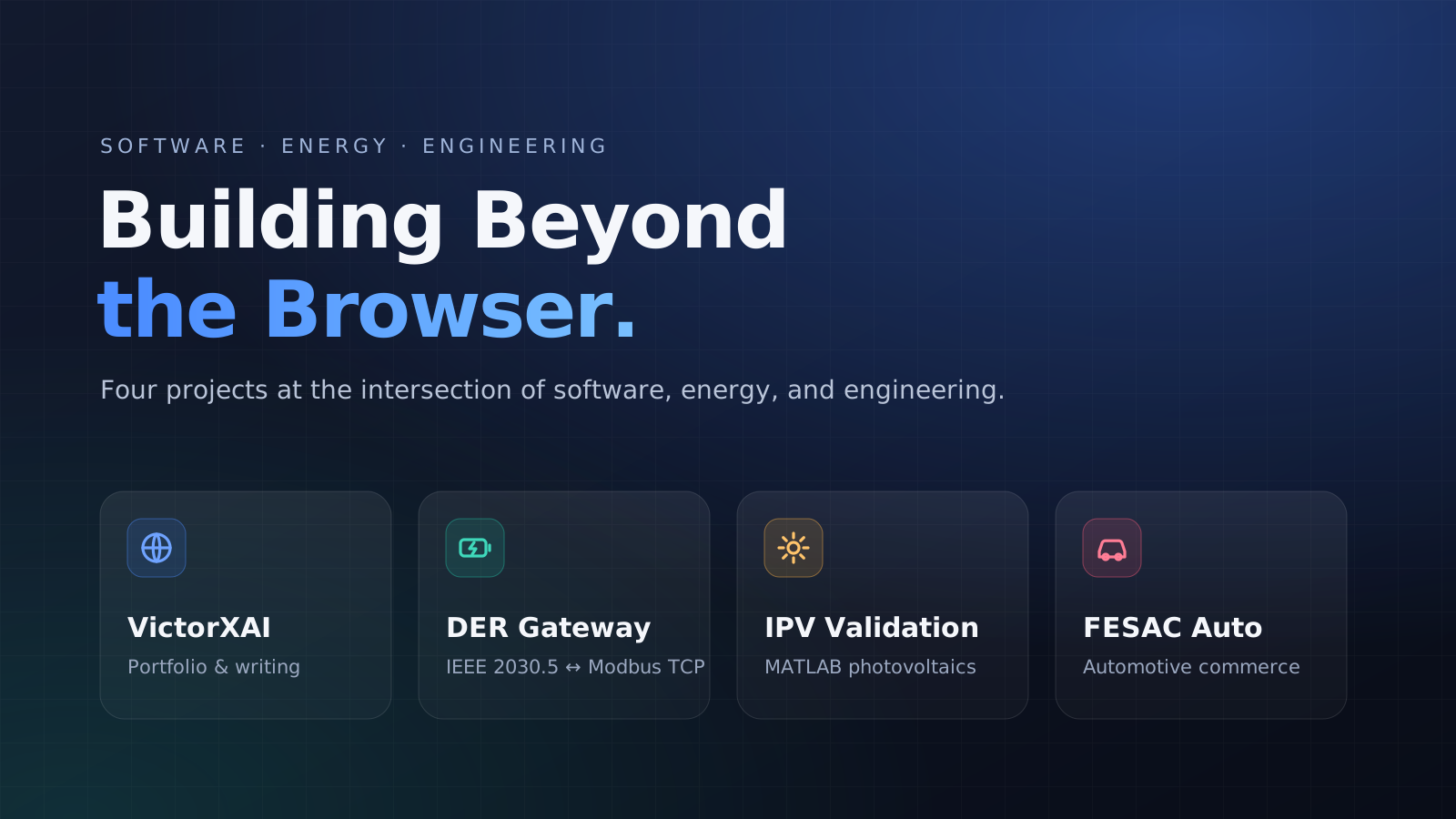
From building digital experiences to validating photovoltaic research and developing energy management systems, these are some of the projects shaping how I approach software development.
I enjoy building software, but I have never wanted my work to be limited to writing code or creating websites. What interests me most is taking a problem, understanding how it works, and building something that makes it easier to solve.
That interest comes from my background in mechanical engineering, my studies in sustainable energy engineering, and my experience developing software for different business needs.
Some of my projects focus on digital experiences and business platforms. Others involve scientific computing, energy systems, and the communication between hardware and software. They are different in purpose, but they share a common goal: using technology to solve practical problems.
Here are four projects that reflect that approach. Each one has its own page with the full write-up.
- VictorXAI: Building My Own Digital HomeMy portfolio and blog: a home for my projects, technical writing and the process behind them, built as an evolving product.
- Interoperable DER Gateway: Connecting Grid Commands to Battery SystemsMiddleware bridging IEEE 2030.5 grid commands with the Modbus TCP interface of an Invinity Endurium battery system, with safe, automated scheduling.
- IPV Spectral Locus Validation: Using MATLAB to Evaluate Indoor PhotovoltaicsA MATLAB workflow that validates indoor photovoltaic data and projects device performance onto reference LED spectra for comparison.
- FESAC Auto: Building a Digital Platform for Automotive CommerceAn automotive commerce platform for discovering, comparing and buying vehicles, with the architecture to grow into a real product.
What these projects have in common
At first glance, these projects may seem unrelated. One is a portfolio, one focuses on energy system integration, another uses MATLAB for photovoltaic research, and another explores automotive commerce.
But they all involve the same fundamental process.
First, understand the problem. Then identify the constraints, design an approach, build the necessary components, and test whether the solution behaves as expected.
The specific engineering challenges change from project to project.
A portfolio requires attention to usability, responsiveness, and presentation. An energy gateway requires careful handling of protocols, operating constraints, and failures. A scientific validation tool requires consistent calculations and transparent assumptions. An automotive platform requires a coherent product experience supported by maintainable software.
Each project has taught me to consider not only whether something can be built, but also how it should work, how it can be tested, and what it will take to maintain it.
That is the kind of developer I want to become: someone who can move between disciplines, understand different types of problems, and use software as a practical tool for solving them.
Looking ahead
I am continuing to develop these projects, improve their documentation, and make more of the underlying work visible.
As the projects mature, I intend to share more technical details, implementation decisions, and lessons from the development process. That includes documenting what works, what needs to change, and what I learn from working through difficult problems.
For me, building software is not just about reaching a finished product. It is also about understanding the problem more deeply with every iteration.
You can follow my work and future technical articles at victorxai.com, or explore the public repositories linked throughout this article.